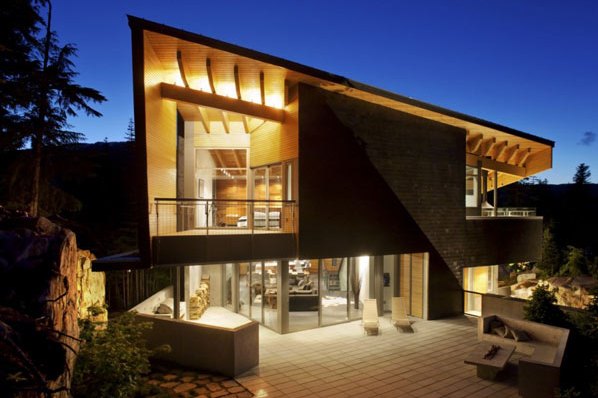
Modern Building With Y-Beams

Follow Us & Network on Facebook and Twitter

By Mark Lundegren

DSC_0661-Edit~2I’d like to introduce you to an alternative building technology of sorts, one called the Y-beam.

Y-beams are fairly easy to use, require no heavy lifting or specialized machinery, and almost always prove unexpectedly powerful when employed in building and design. In practice, Y-beams can be used by anyone and in any type of construction. Indeed, Y-beams even may be the most transformative, cost-effective, and simplifying design and construction technology ever created!

Stateway Gardens

Modern Building Created Without Adequate Y-Beam Use?

Now, you’ve probably heard of an I-beam already, which of course rhymes with Y-beam. But there the similarities definitely end. While I-beams are structural elements that have the shape of the letter “I” in cross-section, by contrast Y-beams have no particular shape. Similarly, while I-beams are usually rigid and straight, Y-beams are completely flexible and can be bent or molded to any design imaginable.

As a practical matter, Y-beams can be used during any phase or aspect of construction. But they are best employed early in the building process. By this, I mean at least beginning with site and foundation preparation, and ideally well before this – in the design and site selection process. On the other hand, perhaps the least desirable use of Y-beams is after project completion, even as this may be their most common use. That said, Y-beams can be successfully used in retrofitting or redesigning existing projects that were envisioned or built without them, or without enough of them.

Continue reading “Modern Building With Y-Beams”

Wabi-Sabi: Beauty On A Budget

Follow Us & Network on Facebook and Twitter

By Mark Lundegren

DSC_0661-Edit~2Whether we are designers, building owners, or renting space, we all have a waiting, frequently overlooked, and remarkably flexible way to stretch our construction and furnishing budgets.

This nearly universal opportunity – literally to create money and materials from thin air – is waiting in front of all of our eyes. Or rather, it is waiting behind our eyes, in the way we use our eyes to look at the world.

The creativity-requiring but resource-leveraging design tool we have in mind is called Wabi-Sabi, which is a Japanese phrase roughly meaning naturally-aged. The term was coined to embody a design tradition that emerged from and is often favored by Japanese Zen culture, reflecting and embodying its special emphasis on attentive life. Importantly, however, this part aesthetic and part philosophical sensibility can be seen as a re-naturalized design or artistic outlook that has re-occurred in various forms across many human cultures and settings.

wabi-sabi cup

Naturally Elegant Wabi-Sabi Tea-Cup

If you are not familiar with Wabi-Sabi, the elegant but decidedly irregular tea-cup above will give you an immediate feel for and introduction to this old and important artistic tradition. It clearly highlights the Wabi-Sabi school’s special emphasis on seeing beauty in things that are natural and aged.

Over time, Wabi-Sabi art and design has become highly elaborated and, with this elaboration, sometimes quite expensive. But this needn’t be the case. In reality, beautiful and disheveled – or beautifully disheveled – and useful Wabi-Sabi objects are usually all around us, are often free or nearly free, and generally can be fashioned with just a bit of curiosity and creativity. All it really takes is an acquired and re-naturalized taste or artistic sense – one that sees natural objects and natural aging as beautiful.

Continue reading “Wabi-Sabi: Beauty On A Budget”

Examining Our Natural Curves

Follow Us & Network on Facebook and Twitter

By Mark Lundegren

DSC_0661-Edit~2This post is a re-print of an article I published on my Mark Lundegren blog, but thought it might be interesting to people who enjoy thinking about shapes and forms, and their power to alter our quality of life.

My title may have led you to think I was going to argue for or against Rubenesque body types, or discuss a fitness insight from my work for HumanaNatura. But I actually want to share a strategy insight and talk about the curves of our lives and groups, rather than those of our limbs and torsos.

Though few of us have considered the idea that our lives and social settings can have a distinct underlying curve or shape, these natural patterns do indeed exist and are discoverable by us. What we might call our life-curves are real and tangible reflections of the way we live and, in particular, how we pattern our actions against our progressive potential. In theory and practice, life-curves prove quite powerful, in the results they create for us,  and as a tool of personal and group strategy and aid to higher quality of life and functioning.

The Core Idea

The core idea of natural curves is that elemental patterns can be shown to underlie all of our lives, even as these patterns remain hidden to us. In essence, our personal life-curve is the overall direction that our life or life trajectory takes over time – again, against our progressive or developmental potential. In practice, understanding and seeing our life-curves is a lot like learning about climate. Like the larger conditions that span and influence the weather we encounter each day. life-curves are subtle but ever-present shapes behind the scenes, but ones that are equally accessible and even equally obvious once grasped.

Continue reading “Examining Our Natural Curves”

On Storage, Space & Stuff

Follow Us & Network on Facebook and Twitter

By Mark Lundegren

DSC_0661-Edit~2There has been a long trend toward larger homes and more things to put in them, and therefore toward larger closets and storage spaces too.

In many upscale dwellings in the developed world, closets now can be enormous and even rooms in themselves. The use of full basements is common as well, creating the potential to match the entire footprint of a home with stored possessions.

But a new and growing counter-trend is gaining strength, questioning the wisdom and even need of this inherited design and lifestyle trajectory. It asks us to consider the optimal size of our homes, and equally the amount of storage space and storable things in our lives.

The Ethos Of Conscious Vs. Conspicuous Consumption In Action

Central to new thinking about the ideal amount of personal space and storables in our lives is the idea that we will naturally fill the space we have…whether it is intended for daily living or housing possessions that do not fit within the regular scope of our day-to-day lives. This space-filling can be the product of the normal goals and inertia of materialist living, or simply from feeling unsettled with and motivated to act on the presence of significant unused or unclaimed space around us.

Though there is limited research of these potentially life-altering domestic phenomena, anecdotal evidence from portraits of large home life today (see here for an example) suggests that we tend to make a good and happy use of a set maximum amount of space and possessions per person. If we strive or are driven to obtain more things and/or more space, we can regressively and ironically overshoot this natural maximum and reduce total quality of life via our added efforts, however well-intentioned they may be.

Continue reading “On Storage, Space & Stuff”

Windows On Our World

Follow Us & Network on Facebook and Twitter

By Mark Lundegren

DSC_0661-Edit~2One of the biggest contributors to successful buildings is the design and placement of windows, including glazed doors and skylights.

While this is measurably and undoubtedly true, the topic of windows is often only a secondary consideration to architects, builders, and building owners…mistakenly taken up after, rather than concurrently with, the planning of walls, roofs, and their structural underpinnings.

We’d like to spend a few minutes discussing some window essentials, to inspire and help you to make superior design and building choices in this crucial area.

Window Comparison

Window Elegance Without Efficiency & Efficiency Without Elegance

The American architect Frank Lloyd Wright was a leader in the integrated use of windows in modern building design. Influenced by traditional Japanese design practices, as his Rosenbaum House above suggests, Wright recommended that window design and placement be part of our overall thinking about a building’s shape and fabric, and the ambient space that floors, walls, and ceilings naturally combine to create.

Wright in particular abhorred design thinking that led to the conceptual cutting of holes in preordained and immovable walls for windows and doors. Instead, he encouraged seeing these building elements in a more holistic way, where permeable and solid materials flowed harmoniously from one to another in designed patterns, each element possessing an intrinsic beauty while contributing to a larger design scheme.

Continue reading “Windows On Our World”

Using Too Much Space?

Follow Us & Network on Facebook and Twitter

By Mark Lundegren

DSC_0661-Edit~2When we look at the trouble and expense that people often go through – as designers, builders, or property owners – to create and maintain modern buildings, one obvious question that comes to mind is – are we simply creating and using too much space?

The decidedly spacious home below, apparently designed to evidence traditional chalet themes, offers a great case in point. The structure obviously cost a small fortune to build and hardly can be seen as a model for sustainable and generalizable modern building.

Buildings Lost In Space

Though striking aesthetically, the building has little alignment with the functional needs and economic constraints of a typical family, or relevancy to the ecological needs and constraints of a society seeking to halt environmental degradation and climate change.

As suggested, one way of bridging this gulf between modern aesthetic expression and our functional requirements is simply to build and use less space.

Though this idea may conjure visions of cramp and forbidding dwellings, or corporate cubicle farms, this of course needn’t be the case – with a bit of ingenuity and some rethinking of the way that we can and might use the space we create.

The 16 Hour Test

To help engender progressive thinking about modern building design and encourage work toward a synthesis of aesthetic, economic, and ecological considerations, I would like to introduce The 16 Hour Test.

Continue reading “Using Too Much Space?”

Cooling More With Less

Follow Us & Network on Facebook and Twitter

Can you name the two pieces of equipment in this photo, and describe how they relate to one another? If you live in a warm climate and occupy a smaller amount of space, chances are you will have little trouble with both parts of this question.

On the other hand, if you live in a colder climate, and have a larger, older, and traditionally-built home, there’s a good chance you may instead struggle with our question.

The Mini-Split

As you might have known already, the items in the photo to the left are the indoor and outdoor components of a small, two-part or “split” air conditioning system, commonly known as a mini-split.

Mini-split systems are commonly-used in many parts of the world, but are almost unheard of in other places. But this heating and cooling divide is changing, as building quality and energy efficiency standards improve, making mini-splits a logical choice in all but the coldest of climates.

Continue reading “Cooling More With Less”

New Life In An Old Idea

Follow Us & Network on Facebook and Twitter

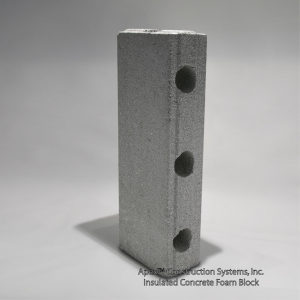
The building block has been around for a while. It arrived sometime after the thatched lean-to and hut, and long ago offered us a new, economical, and more protective way of building, especially as our early towns and cities formed.

Given ArchaNatura’s mission to promote progressive building and design, it might be a surprise that our first post would involve the seemingly lowly and decidedly retro building block.

After all, as a building material, blocks may be low-cost, but they are heavy, a pain to transport, and offer poor thermal characteristics. Blocks can shake apart in earthquakes and storms without added reinforcement. And in any case, they are labor intensive and fairly inflexible when complex building forms are desired. In a word, blocks have been done.

Continue reading “New Life In An Old Idea”

Anyone Out There?

Follow Us & Network on Facebook and Twitter

We’re just getting this new site going, but have the initial layout, support pages, and widgets in…feel free to have a look around.

Watch for refinement of the pages and our first posts beginning in October. In the meantime and as our post stream develops  your comments & suggestions are always welcome!

Health & best wishes,

– AN